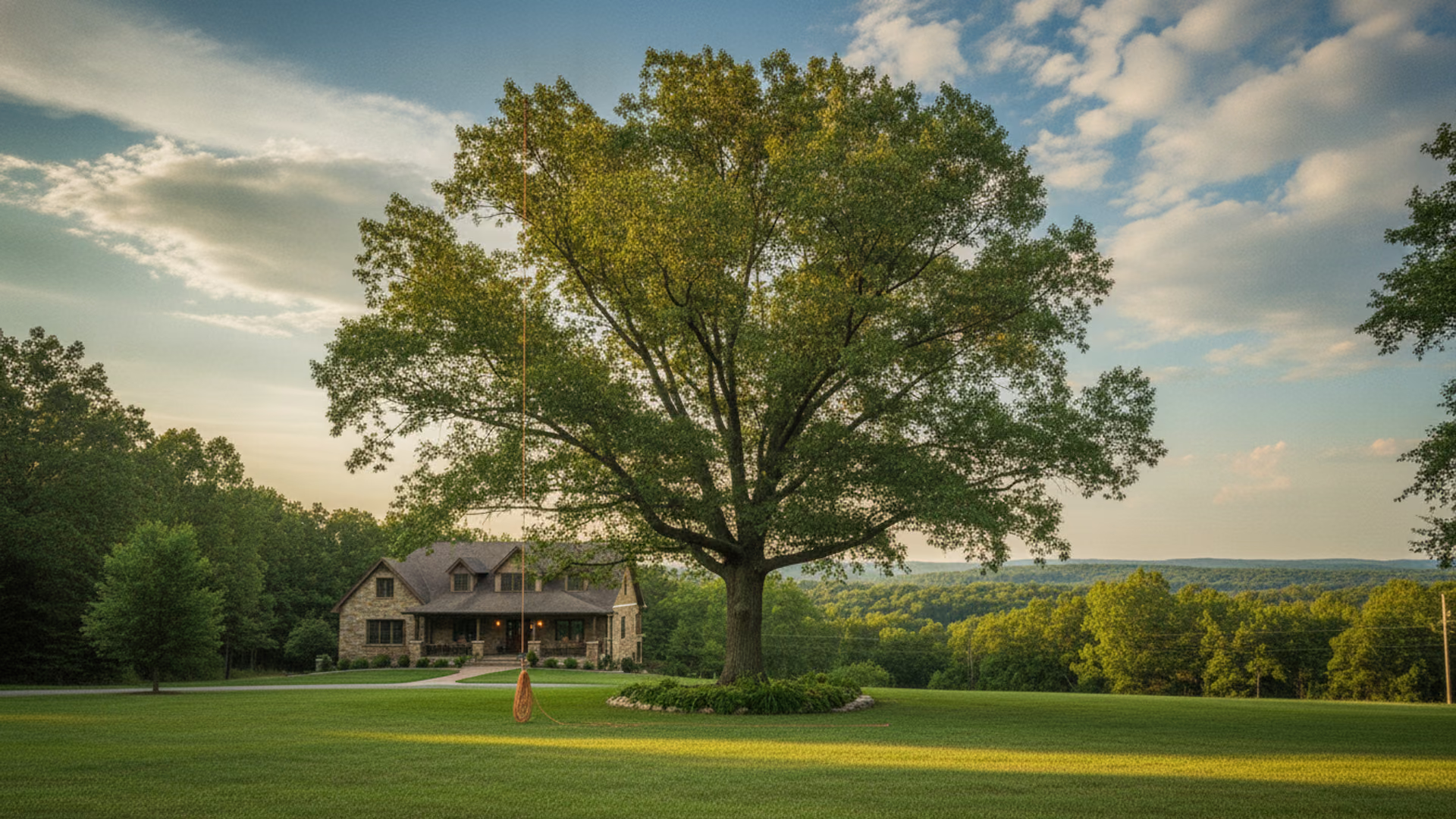
The limb that's bothering you is usually easy to describe. An oak branch resting on the shingles that scrapes every time the wind picks up. A silver maple that's swallowed a bedroom window. Branches touching the roof over the back porch, or an overgrown tree too close to the house that nobody has touched in twenty years. That's what tree trimming in Springfield, MO is actually for — and done right, it's pruning, not hacking: selective cuts that restore clearance, take dangerous weight out of the canopy, and leave the tree healthier and better-shaped than it was. We handle trimming and pruning for homes and businesses across Springfield, Greene County, and roughly 30 miles in every direction, and every job starts with a free written estimate.
Crown Thinning vs. Topping — the Cut We Refuse to Make
There's one job we turn down on principle: topping. Shearing a tree flat looks like a solution — the tree is shorter, the roof is clear — but the cuts land in the middle of limbs instead of at a growth point, so the stubs rot instead of sealing. The regrowth that follows is a dense mat of water sprouts attached only to the outer wood, and those sprouts snap in the first serious ice load. Within about five years a topped tree is taller, uglier, and more dangerous than the tree you started with. Midtown's overmature silver maples are the local poster child — fast-growing, hollow-prone, and exactly the trees door-knocking topping crews target.
A proper reduction does what topping pretends to do. Each cut goes back to a living lateral branch big enough to take over as the new end of the limb — what arborists call a drop-crotch cut. The tree gets shorter and lighter, keeps its form, and seals its wounds. That's the standard anyone searching for an arborist in Springfield, MO should hold every bidder to, whatever the truck says on the door.
Thinning, Raising, Reduction, and Deadwooding — in Plain English
The pruning menu sounds like jargon until you translate it:
- Crown thinning — removing select interior limbs so wind moves through the canopy instead of shoving against it. Light reaches the lawn again, and weight comes off the scaffold branches.
- Crown raising — taking off low limbs for clearance over the roof, the driveway, the sidewalk, and sightlines at the corner.
- Crown reduction — properly shortening height or spread with cuts back to laterals. This is the honest version of what topping fakes.
- Deadwooding — stripping the dead limbs out of the canopy. Deadwood is what comes down uninvited on a calm day, usually onto whatever is parked under it.
Crown thinning and deadwooding together are the workhorse prescription for a big neglected shade tree: the canopy gets lighter, safer, and easier to read. One caution, though — heavy deadwood can be a symptom, not just a chore. If a third of the crown died back this year, prune-and-hope may be the wrong plan; here's how to tell if a tree is dying before you spend money trimming it.
Pruning on the Ozarks Calendar: Oaks After Leaf Drop
Springfield sits in the Ozarks oak-hickory canopy, which means a huge share of the trees worth trimming here are oaks — and oaks carry a rule the rest of the yard doesn't. Oak wilt spreads when sap-feeding beetles land on fresh pruning wounds, and those beetles fly in the warm months. A spring or early-summer cut on an oak is an open invitation; a dormant-season cut is not. So the calendar for tree pruning in Springfield, MO looks like this: oaks and most large shade trees from November through February, when the beetles are grounded, the branch structure is visible without leaves, and the cuts heal into spring growth. Deadwooding and clearance work can happen almost any month. Storm-cracked hangers come down immediately, whatever the calendar says.
Leaf drop is also inspection season. Cavities, dieback, and the tight V-shaped forks that hide included bark all show plainly once the canopy is bare — the problems summer foliage covers up. For the full month-by-month breakdown, see our guide to the best time to trim trees in Missouri.
Weight Off the Roof Before Ice Season
Springfield's storm math is worth stating plainly. The January 2007 ice storm put roughly two inches of glaze on the city, knocked out power to about three-quarters of City Utilities customers, and left parts of Greene County dark for weeks. The April 29, 2025 windstorm — a 91-mph gust at the airport, around 50,000 CU outages — was the worst since, and proof the threat isn't history. Ice is simple physics: a glaze coating multiplies a limb's weight many times over, and the limb that fails is almost always the long, heavy, over-extended one — the lead hanging over the master bedroom, the service drop, or the driveway.
The highest-value scheduled trim in this market is pre-storm weight reduction: shortening and thinning those heavy leads before December glaze or April wind finds them. Lightening that limb in October is a planned job with a written price. Cutting it off the shingles in January is not.
Power Lines: What City Utilities Clears — and What's Yours
After 2007, City Utilities got aggressive about line clearance, and homeowners deserve a straight answer about where the utility's lane ends. CU crews trim the corridor along the pole-to-pole primary lines on their own cycle — limbs growing into those high-voltage lines are CU's call, and no private crew should be in them. The homeowner's side of the split is the service drop from the pole to the house and every tree on the property below it. That's our lane, and it's worked with controlled cuts — pieces held and lowered, never free-falled onto the drop, the roofline, or the fence. In Rountree, Phelps Grove, and University Heights, where century-old canopy threads through small lots and old service drops, that split is the difference between a trim and an outage.
The Callery Pear Problem — What Pruning Can and Can't Fix
Honesty about limits matters here. The Bradford and Callery pears planted across Springfield's 1980s–2000s subdivisions split at their tight, included-bark branch unions in nearly every windstorm — after each front, pears end up on cars and gutters across town. Pruning has a real but limited role: a young pear can be structurally thinned to reduce its sail and slow the inevitable. A mature pear with multiple codominant leaders and included bark, though, cannot be pruned into a sound tree — the flaw is the structure itself. At that point, taking the tree down is the straight answer, and Missouri sweetens it: the MDC Callery pear buyback trades a free native tree for each pear you cut down, because the species is invasive.
Serving Springfield and the Surrounding Area
SGF Tree Removal handles trimming and pruning across Springfield, Greene County, and roughly 30 miles in every direction — residential and commercial, from the hundred-year canopies of the city's historic neighborhoods to the newer subdivisions south toward Nixa, where 1990s-era plantings are hitting their first big structural decisions. Every job starts with a free written estimate: walk the trees with us and get a clear scope before anyone starts a saw. And if a limb is already cracked or hanging, that's not a trim — we run 24/7 storm damage and fallen tree response. For everything that can be planned, Get a Free Estimate or call (417) 742-8635.